
Legal and administrative case files
We designed and developed a document analysis application that turns a complex legal or administrative case file into organised knowledge that can be queried and checked: every conclusion is linked to the document it comes from.
The problem
A complex case file is rarely a tidy set of documents. Contracts in Word, land registry extracts and expert reports that have been scanned (often with handwritten notes), email threads, digitally signed attachments, photographs: tens or hundreds of files to read, cross-check and cite correctly. It happens in litigation and legal cases, but also in public tenders, permits and dealings with public authorities, where a file keeps growing for years. Before even getting to the substance, whoever handles the case spends days just putting things in order.
How the document analysis works
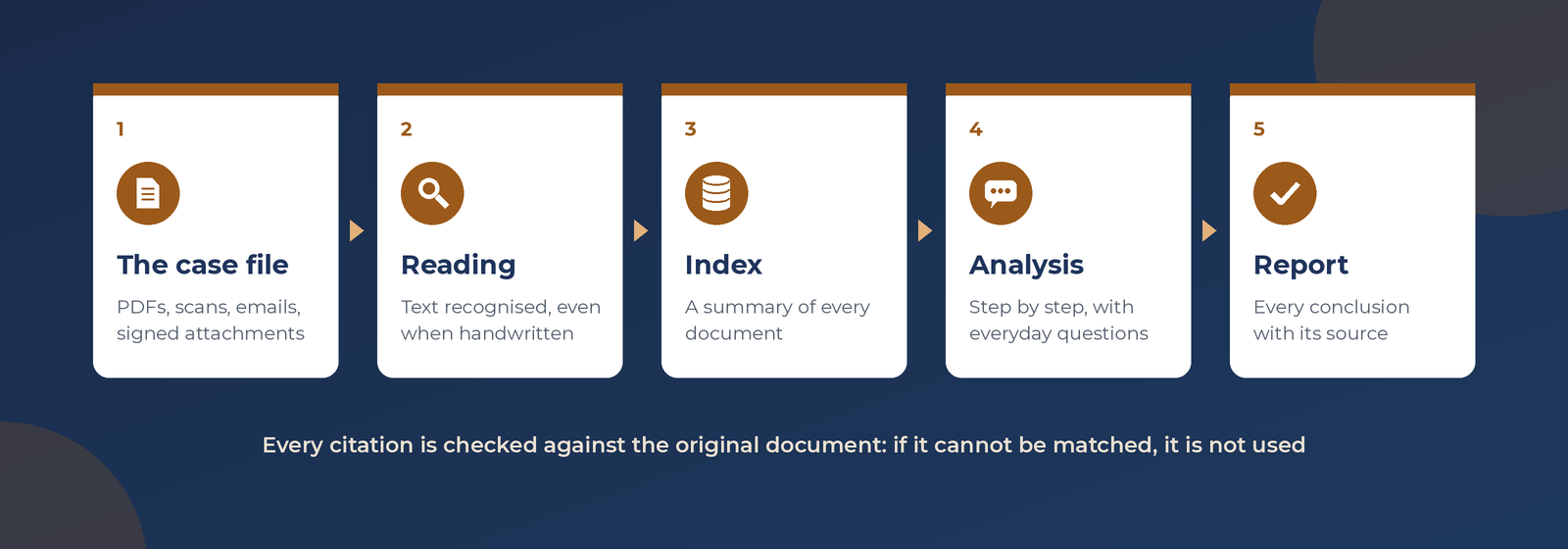
- It takes the case file as it is: each type of file follows the most suitable path. PDFs are read directly; scans go through text recognition (OCR) with several engines in sequence, which also recovers difficult handwriting, stamps and damaged documents; emails are opened together with their attachments, including digitally signed envelopes (.p7m, the Italian standard).
- Guided, step-by-step analysis: the system supports a first structured analysis of the case.
- Questions in plain language: you can query the whole file (“when was the formal notice served?”, “which permits are missing?”) and get answers with their sources.
- Reports ready to share, in Word or HTML, with every conclusion linked to its source document.
Why the answers can be trusted
In legal and administrative work, an AI that invents even a single detail is unusable. That is why we built two specific mechanisms:
- No document left out: with case files made of many files, automated search risks “seeing” only part of them. The system prepares a summary of every document and keeps it in view in every analysis.
- Verified citations: every reference produced by the AI is compared with the original text. If a statement cannot be matched in the sources, it is not cited.
The application was developed and tested on real case files. The judgement remains with the person: the AI lets them start from the right point, with an organised picture and traceable sources, and cuts the time spent on preliminary research dramatically.
Confidentiality of documents
The solution runs either on the cloud services of the major platforms, configured to protect your data (documents are not used to train the models and, where possible, data is kept in Europe), or only on models installed on your own computers, so documents never leave the company. Read more about local AI.
How it can help your company
The same approach works for any complex document archive: contracts with suppliers and customers, tender files, technical or quality documentation, compliance dossiers. We start from your case with our method: a prototype in 4 weeks on your documents, then the full solution if the result convinces you. See how we work on the AI Solutions page.
AI document analysis is most useful when there are many documents, in different formats, that need to be consulted often: legal and administrative departments, professional firms, companies that take part in tenders or manage permits and certifications. In these cases, the time saved on searching becomes more time for evaluation, which always stays with people.
For developers
An installable application written in Python, with a semantic index of the documents and text recognition run in parallel page by page. Two components have been published as open-source software by a member of our team, and anyone can review the code: ocr-cascade (multi-engine text recognition) and verified-citations (citation checking).
Let’s talk
We can show you the solution on a sample case file. For a free initial call of 20–30 minutes, write to info@lekton.ai or use the Contact page.