With AI Governance we bring order to how artificial intelligence is used in your company: who uses what, with which data and with which risks. We then turn this into rules, training and documents that stand up to an inspection, as required by the EU AI Act (Regulation (EU) 2024/1689).
Who it is for
For small and medium-sized businesses that use AI systems developed by others: assistants such as ChatGPT, chatbots, recruitment software, business software with AI features. The AI Act calls them “deployers”, and it sets specific obligations for them too.
What the AI Act requires
- From 2 February 2025: measures to develop staff AI literacy (Article 4, as amended by Regulation (EU) 2026/1744).
- From 2 August 2026: transparency obligations (Article 50), for example disclosing that a chatbot is an AI system, and supervision by national authorities.
- From 2 December 2027: obligations for high-risk systems, including those used to recruit and manage staff: human oversight, record-keeping and information to workers (Article 26).
Many member states are adding national rules, especially on AI in the workplace. In Italy, for example, AI that affects how work is organised must be included in the occupational risk assessment and in worker training. For international groups we take into account the rules of the countries where your companies operate, together with your legal advisers.
How we work
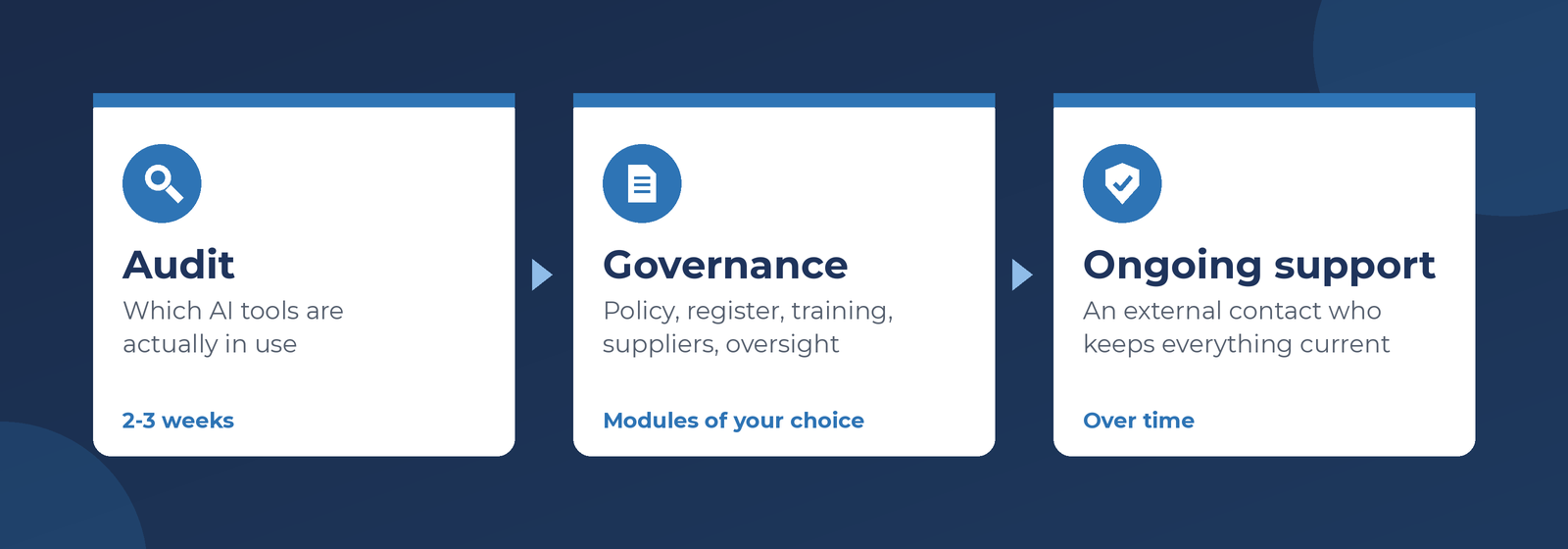
Audit
We interview department heads and check IT data, so that we also find tools adopted without authorisation. We classify each system under the AI Act and show what is missing. The result is a register with the risk level of each tool.
About 2-3 weeks.
Governance
Based on the audit, you choose the measures you need, even just one: a policy and roles, with a kit that explains them to managers; a procedure for approving new tools; supplier assessment; effective human oversight and information for workers. At the end you have documentation ready to show in an inspection.
Training by role
It can also be bought on its own, without an audit: one opening session for the whole company and short modules by role (for example HR, marketing, administration), with exercises on real cases, a final test and a certificate for each person. It is the AI literacy training required by Article 4 of the AI Act.
Ongoing support
If you choose, we stay alongside you as an external point of contact (Fractional AI Officer), with a minimum commitment of 6 or 12 months. We update the register, assess new tools, review with management every quarter how the rules are applied, update the training and support you in an inspection.
On request, we support companies towards ISO/IEC 42001 certification, issued by an accredited body.
What sets us apart
- An internal contact person: we ask the company for one person with the mandate to lead the process.
- Rules, not culprits: we explain to the people we interview that the aim is to agree common rules, not to look for someone to blame.
- Shadow AI always included: at every stage we also check tools used without authorisation.
- Legal aspects covered: for contract clauses and policies we involve a lawyer or an employment law adviser, if the company does not have one.
- Your documents: documents and checklists you manage yourselves, with no software to buy; everything we produce stays with the company.
- No conflict of interest: we do not sell AI tools. If your company uses solutions built or recommended by Lekton.AI, we declare it in writing and do not assess those solutions ourselves.
For a free initial call of 20–30 minutes, write to info@lekton.ai or use the Contact page.